Moving abroad or expanding your business to another country can mean a lot of paperwork. One of the most confusing parts is figuring out what kind of translation officials will accept.
You might already have a professional translation. But in countries like Italy, France, or Spain, it may not be enough. Many offices ask for a sworn translation.
A sworn translation is different from a standard one. It’s done by a translator who is officially authorized, and it comes with a signed statement that makes it valid for legal use. If you’re submitting a diploma, birth certificate, or contract, knowing this early can save you time and avoid rejections.
This guide provides a deep dive into what sworn translations are, why they carry such unique weight, and when you absolutely cannot afford to go without one.
What exactly is a Sworn Translation?
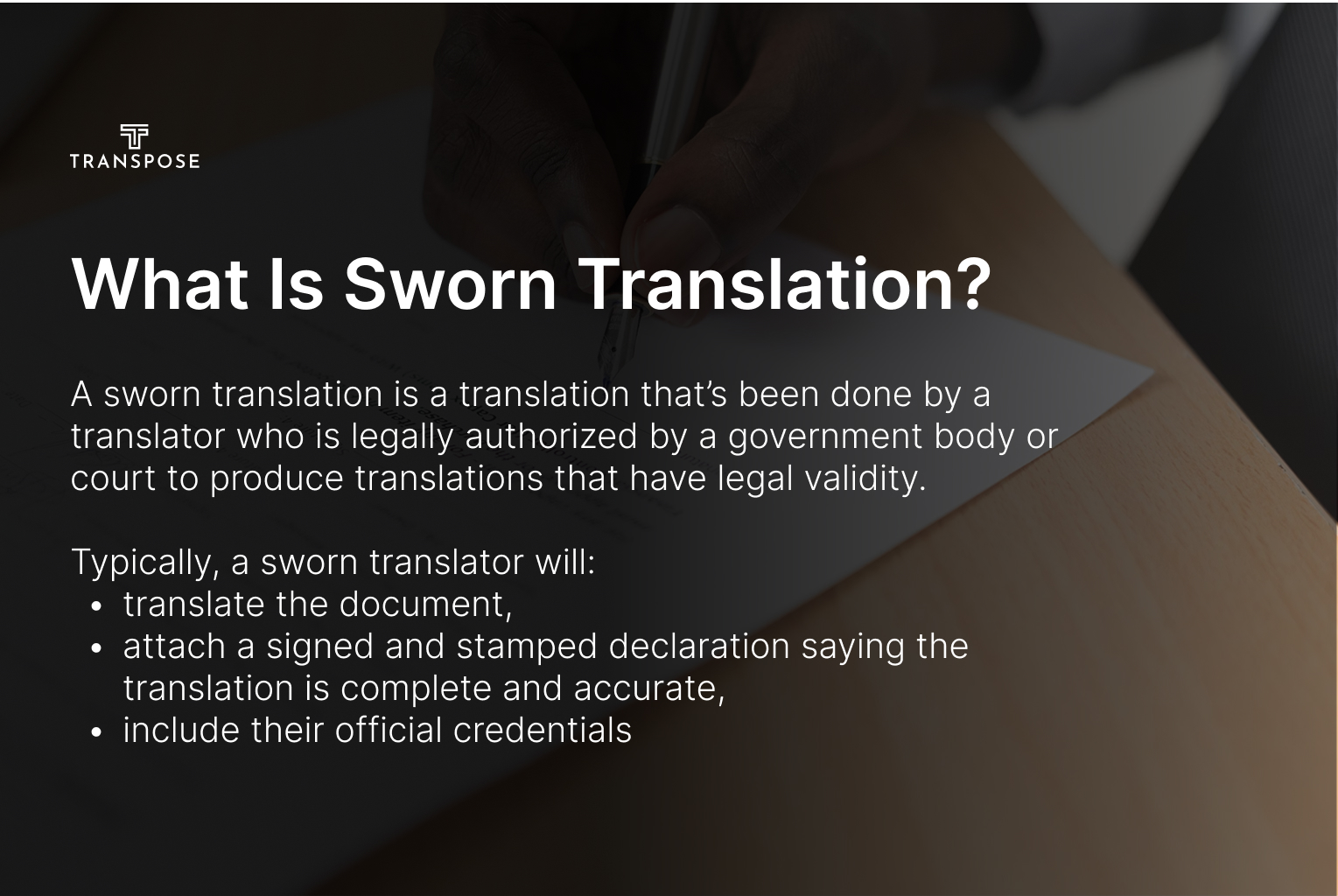
A sworn translation is an official translation used for legal or administrative purposes. You may also hear it called a public or official translation, depending on the country.
Unlike a regular translation for business or marketing, a sworn translation has legal weight. It is made by a translator who has been formally authorized by a public authority.
Once the translation is “sworn,” it is treated as the legal equivalent of the original document. In other words, officials can accept the translated version as if it were the original.
In many places, the process includes a formal step where the translator declares—before a court officer, notary, or registrar—that the translation is complete and accurate.
The Role and Responsibility of the Sworn Translator
Who translates your document matters as much as the translation itself. A sworn translator is not just someone who speaks two languages. They are a translator who has been officially authorized by a court or government office to certify translations.
In many European countries, such as France and Spain, sworn translators are listed on official registers. These lists are often managed by local courts or government departments. To be accepted, translators may need to prove their language skills, show relevant qualifications, and pass background checks.
This role comes with real responsibility. When a sworn translator signs and stamps a document, they take legal responsibility for its accuracy. If they make a serious mistake or leave out important information, it can become a legal issue—not just a simple error. That’s why many authorities trust sworn translations: they come with a strong legal guarantee.
Distinguishing Sworn, Certified, and Notarized Translations
A lot of people get confused because the terms certified, sworn, and notarized translation are often mixed up. Some countries even use the words as if they mean the same thing. In reality, they can be very different.
-
Certified translation is common in places like the UK, the US, Canada, and Australia. A translator or agency adds a signed statement (sometimes called a “statement of truth”) saying the translation is accurate. This is usually enough for local use, but it may not be accepted in many Civil Law countries.
-
Sworn translation is usually required in Civil Law countries such as Italy, Spain, France, Germany, and many countries in South America. Here, the translator must be officially approved by a court or public authority. The translation is treated as a legal document, not just a translation with a signature.
-
Notarized translation adds a notary public into the process. The translator signs the certification in front of the notary, and the notary confirms the signer’s identity. The notary does not check the translation itself—only who signed it. This is sometimes requested when the destination country doesn’t have a formal sworn-translator system.
When and Why is a Sworn Translation Mandatory?
You usually need a sworn translation when you are submitting documents to an official authority - a governmental or judicial body in a country that operates under a Civil Law system. This includes places like city halls, courts, immigration offices, and sometimes universities. These institutions often won’t accept a normal translation, even if it was done by a professional.
The reason is simple: the country’s legal system needs a translation that has official legal value. For example, if you are filing documents in an Italian court or applying for citizenship in Spain, the authorities must be sure the translation matches the original exactly.
A sworn translation provides that guarantee. It comes with the translator’s official status, signature, and stamp (and sometimes a formal declaration). Without those elements, the document may have no legal standing and can be rejected.
Which Documents Typically Require Sworn Translation Service?
The list of documents that might need to be sworn is extensive and covers almost every aspect of legal and professional life.
- Personal and Vital Records: Birth, marriage, death, and divorce certificates are the most common. These are essential for visa applications, residency permits, and naturalization processes.
- Academic Credentials: To have your education recognized abroad, you will often need sworn translations of your diplomas, university degrees, and academic transcripts.
- Legal and Judicial Papers: This includes court rulings, will and inheritance, powers of attorney, and criminal record checks.
- Business and Corporate Documentation: Companies expanding internationally often require sworn versions of their Articles of Association, certificates of incorporation, patents, and audited financial statements.
- Identification: Passports and driving licenses frequently require this official treatment when used for legal identification purposes in a foreign country.
The Step-by-Step Process of Obtaining a Sworn Translation
Getting a sworn translation is more formal than a standard translation. The exact steps depend on the country, but the process often looks like this:
- Prepare the original document: In many places, the translator may need to see the original paper document (not just a scan). Some won’t stamp the translation unless they can check the original.
- Translation: The sworn translator translates everything carefully. This includes not only the text, but also stamps, seals, signatures, and notes. The layout is often kept close to the original too.
- Sworn statement (oath) step: Once finished, the translator completes the official declaration. In some countries, they sign it before a court official or a notary, who may add their own stamp.
- The “bundle” is created: The original document, the translation, and the declaration are attached together (often stapled and sealed). This is important: if the pages are separated, it can lose legal validity.
- Delivery: You receive the stamped, signed paper set. A PDF copy may be provided for convenience, but the physical version is usually the one that authorities treat as fully valid.
The Role of the Hague Apostille
Often, a sworn translation is not the only thing you need. If your document is going to a country that follows the Hague Apostille Convention (1961), you may also need an apostille.
An apostille is a special certificate that confirms the signature and seal on a public document are genuine. It does not confirm that the translation is correct. It only confirms that the official who signed or stamped the document is real and authorized.
In many cases, it’s smarter to get the apostille on the original document first. That’s because the apostille page itself often has to be translated and included in the final sworn “bundle.”
Further readings:
- Documents That Need Legal Translation
- Professional Translation Agency vs Freelance Translator: Which One to Choose
- Most Frequently Asked Questions About Certified Translation
Do you have documents that require professional translation? At Transpose, we provide accurate, certified translations that meet ISO 17100 and 18587 standards for legal, official, or regulatory use. For consultation or quote, email us at trp@transpose.ch or call +41 22 839 79 79 today.